Pre-Assay Geological Intelligence

Cauldra

Pre-Assay Geological Intelligence for Cu-Au Porphyry Systems.

Cu-Au Porphyry Machine Learning Pre-Assay Analytics

Cauldra turns standard core logging data into a quantitative read on grade — predicting high-grade intervals and ranking the geological controls behind them, weeks before assays return from the lab.

The Problem

The decisions come before the assays do.

Step-outs, hole extensions, target ranking, lab queue priority — the calls that shape a program happen while the rig is turning and the lab is weeks behind. Logging already captures what should predict grade. Cauldra makes it quantitative — before assays return.

Method

Two products. One input: your logging data.

Product 01

Pre-assay triage

When Cauldra deprioritises an interval, it is correct more than nine times in ten.

A ranked list of intervals by likelihood of hosting high-grade copper, with confidence tiers and geological reasoning. Project geologists adjust hole plans and step-outs weeks ahead of the lab.

Product 02

Geological signal

Independently recovers the geological controls operators document — validated across three independent BC porphyry systems.

Cauldra identifies which lithologies, alteration assemblages, and sulphide associations matter — produced from logging alone, without access to the operator's interpretation.

Deliverables per engagement
Interactive dashboard
Ranked intervals, confidence tiers, and the geological reasoning behind every call.
Leapfrog-ready OMF export
Predictions and drivers loaded straight onto your drillholes.
Written geological brief
Documented controls on grade — lithology, alteration, sulphide associations — with interpretation context.
Sample Output

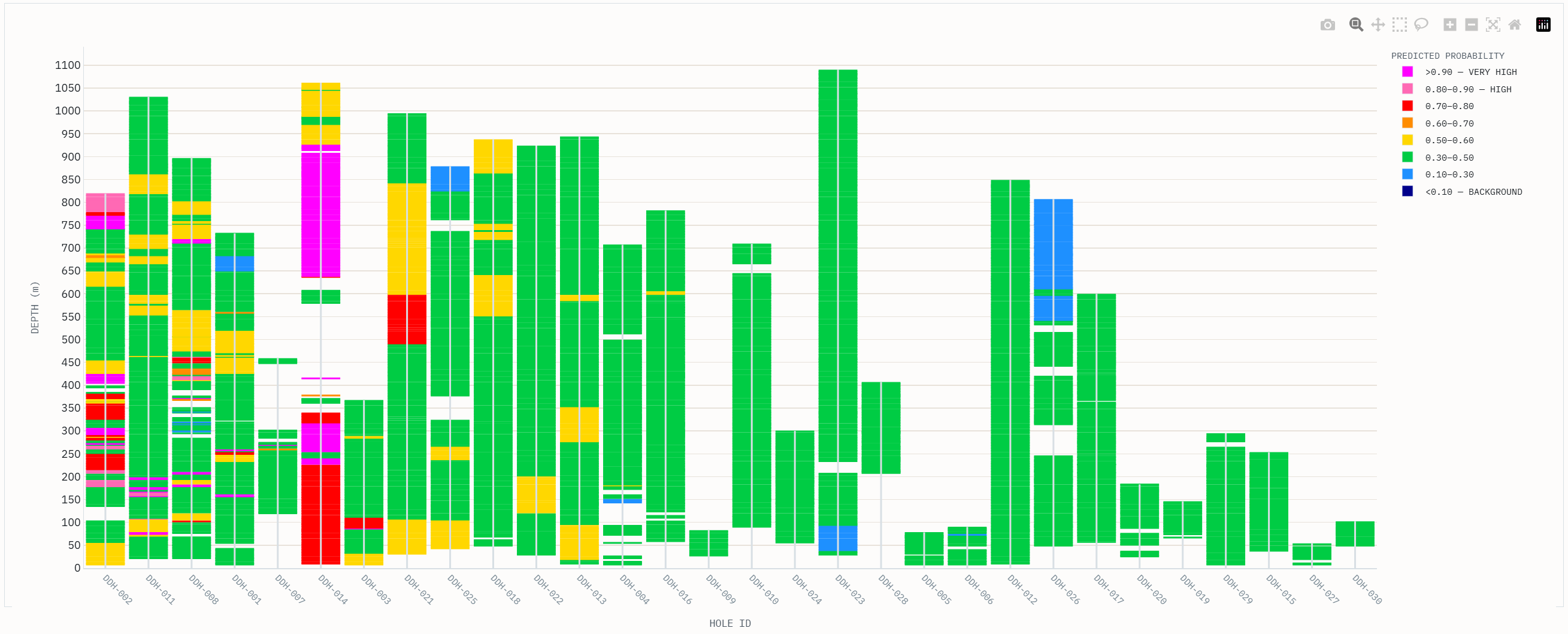
Every hole, every interval, scored.

The model's predicted probability that each logged interval exceeds the deposit's Cu p90 threshold. No assay results seen by the model — predictions made from logging alone. Hover any interval for depth, probability, lithology, and alteration.

Source: Publicly disclosed BC ARIS assessment report data. Hole identifiers anonymised for public display.

LOADING INTERACTIVE CHART
Sample downhole grade prediction output from Cauldra dashboard — every logged interval scored by predicted probability of high-grade copper, coloured magenta to dark blue from highest to background probability

Sample from validation case study · Trained on 2021–2022 logging, predicted 2023 program blind · Operational triage model output

Results

Validation on public datasets.

Cauldra has been trained and validated across three independent BC porphyry systems — different terranes, different operators, multiple drill seasons. Over 300 drillholes and 130,000+ metres of logged core. The case study below uses publicly disclosed BC ARIS drill data from a North American Cu-Au porphyry project across three consecutive programs (2021, 2022, 2023). Cauldra was trained on the 2021 and 2022 logging records and ran on the 2023 program blind. The model's outputs match the geological controls documented in the operator's published assessment reports — produced from logging alone, without access to the operator's interpretation.

The model recovers the porphyry zoning framework from logging alone — productive intrusive hosts, barren post-mineral dykes, sulphide paragenesis, and alteration zoning.

  1. Porphyritic diorite phases as the primary mineralised hosts. Five intrusive lithology codes appear in the top seven predictive features — matching the productive hosts described in the operator's assessment reports.
  2. Post-mineral monzonite dykes as negative grade contributors. The paragenetic distinction between mineralised pre-mineral diorite and barren late monzonite intrusions emerges from logging alone — the same separation documented in the published interpretation.
  3. Sulphide paragenesis in the documented order. Chalcopyrite as the strongest positive sulphide signal, followed by bornite — matching the operator's stated abundance for grade-relevant sulphides.
  4. Potassic and phyllic alteration as the productive assemblages. Both rank in the top fifteen predictive features. Propylitic alteration carries no predictive weight — as expected for the distal halo that surrounds but does not define the ore zone.

The geological controls on grade are learnable from standard core logging data — independently of the operator's interpretation. For an active program, that means a calibrated read on grade as logging comes in, weeks before assays return.

Validation

Why it holds up.

Trained and validated across three independent BC porphyry systems spanning different terranes, operators, and logging conventions.

Validation type AUC range NPV
Same program 0.75 – 0.80 > 95%
Cross-year 0.73 – 0.86 > 90%
Cross-deposit 0.72 – 0.82 > 86%
AUC
Discrimination accuracy — how reliably the model ranks high-grade intervals above background. 0.5 is random; 1.0 is perfect.
NPV
Deprioritisation accuracy — how often a low-priority call is genuinely below the high-grade threshold.

The model is not memorising a deposit. It is learning the porphyry signal that transfers between systems — with no retraining.

Scope

Copper is ready now. Gold is in active development.

Production-ready

Copper

Strongly tied to logged sulphides and alteration. Validated across three independent BC porphyry systems with no retraining between deposits.

In development

Gold

Nuggety and structurally controlled. Active work on where logging-plus-geochemistry can predict it reliably. Not claimed as current capability.

Contact

Let's talk about your data.

Open for engagements.

The geology shapes the model. The model sharpens the geology. That's the product.

Location
Remote · Available globally
Web
cauldra.ca
Send a message